VALIDATED ACROSS 40+ COMPANIES • ILO CONVENTION 190 ALIGNED
Innovative leadership transforms organisations with our groundbreaking, data-driven harassment risk assessment. We help prevent catastrophic failures, reduce losses, boost productivity, and retain top talent, all while shielding workers and their families from the devastating effects of workplace harassment.


Our Founding Mission
The Resilient Workplace Institute is a non-profit organisation with Public Benefit Status dedicated to making workplaces safer and more dignified whilst preventing catastrophic governance failures. Our mission is to make harassment risk visible, measurable, and preventable on a global scale—protecting both human dignity and organisational integrity.
We discovered that harassment systematically silences the voices that could prevent disasters—whilst simultaneously destroying the lives of those who tried to speak up.
Our Solution: The Harassment Risk Index
The HRI is the world's first diagnostic tool providing 12-18 months early warning of governance collapse whilst simultaneously protecting workers from immeasurable suffering.
For Governments, Companies & Institutions: We transform workplace harassment from an unmeasured liability into quantifiable competitive intelligence that drives profitability, retention, operational excellence, and Enterprise Risk Management.

40+Companies

79k+Data Points Analyzed

3 out 10Report High Harassment
"Culture is not a mystery—it's measurable."
The 10 Golden Nuggets That Transform Workplaces
01
Predict What's Coming
Detect early warning signs 18 months ahead.
02
Target With Precision
Pinpoint harassment hotspots by team, level, or demographic.
The Silent Risk
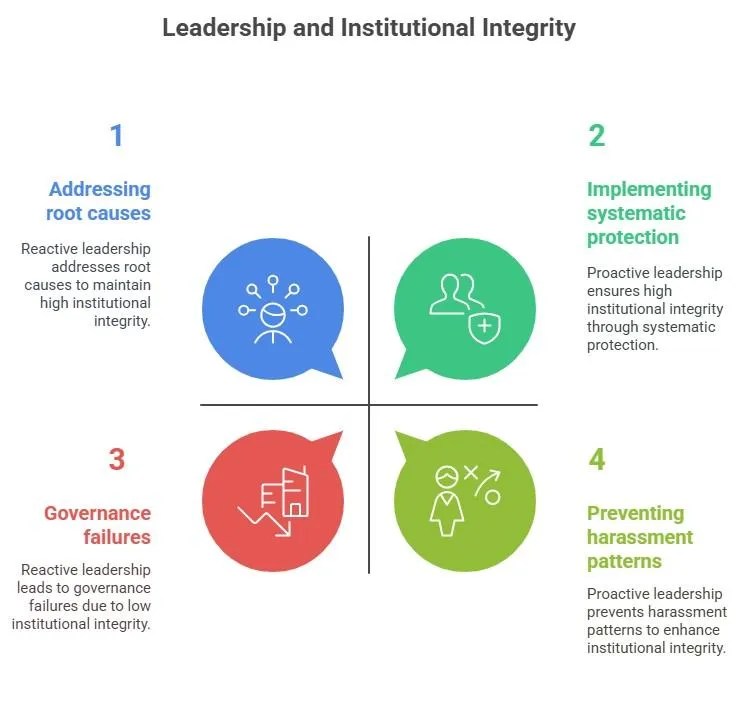
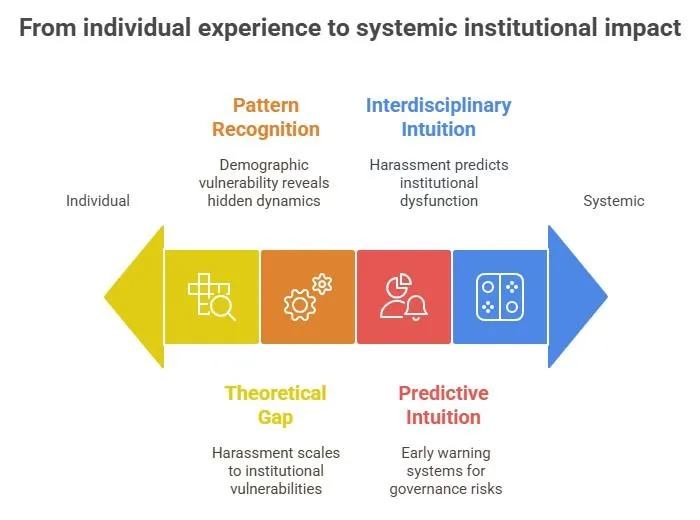
Harassment isn't just an HR issue; it’s a measurable early warning sign of systemic governance failure.
03
Benchmark Your Culture
Compare across departments, industries, and national averages.
04
Protect Strategy
Neutralize the cultural toxins that undermine your strategy.
05
Make the Invisible Measurable
Quantify workplace toxicity with a risk index grounded in real data.
Beyond Sentiment
We measure concrete behaviors, not just feelings, transforming vague cultural assessments into predictive, quantifiable intelligence.
06
Turn Risk into ROI
Track savings in absenteeism, turnover, and productivity.
07
Build ESG Credibility
Prove your "S" in ESG with metrics that align with ILO C190.
08
Boost Resilience & Innovation
Psychological safety drives adaptive, high-performing teams.
09
Empower Leaders with Truth
Bridge the gap between leadership perception and employee reality.
10
Diagnose Culture
Understand the root causes of issues, not just the symptoms.
Who We Help
We provide tailored tools and insights for leaders across all sectors. Click a role to learn more.
Set the Standard
Benchmark ILO C190 and SDG 10.3.1 progress using aggregate data
New Data. New Research.
Access anonymised harassment risk patterns and prevalence heatmaps.
Equip Inspection Systems
Apply risk insights to national enforcement and employer compliance.
Measure What Matters
Reduce harassment, improve culture, and report on psychological safety.
Get an Investment Edge
Get a leading indicator that reveals more than what is obvious.
For POLICY INFLUENCERS & ILO TECHNICAL STAFF
A Robust, Scalable Approach
The Harassment Risk Index (HRI) offers policymakers and international institutions a robust approach to measuring workplace harassment. Developed using anonymised data from over 40 companies, the HRI enables countries to:
Monitor alignment with SDG indicator 10.3.1.
Operationalise Convention 190 reporting using empirical benchmarks.
Compare sector- or gender-specific harassment trends.
Support labour law reform, enforcement, and resource planning.
For ACADEMICS & LABOUR RESEARCHERS
Access Research-Grade Data on Workplace Harassment Risk
Seeking novel data on workplace well-being? The HRI offers a rich, anonymised dataset with segmentations by gender, race, sector, and job level from 40+ company assessments.
Provides prevalence data from 40+ company assessments
Allows for comparison of top harassment types across demographics
Enables pattern analysis across time, geography, and industry
Collaborate With Us
We're working with leading South African universities and welcome proposals for joint publications.
FOR GOVERNMENT POLICYMAKERS & LABOUR INSPECTORS
Equip Your Inspection Framework with Risk Intelligence
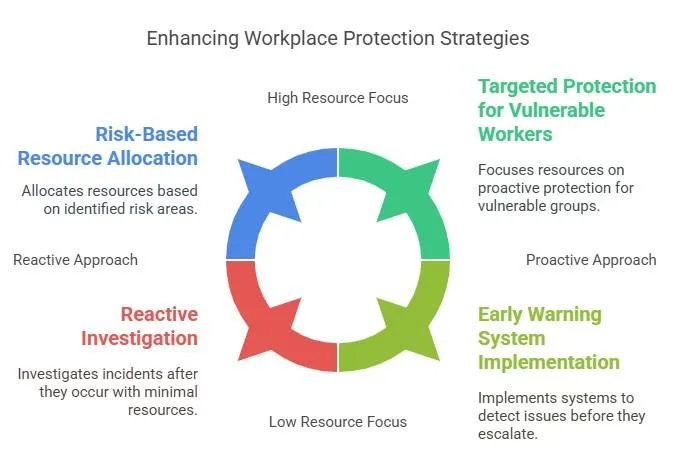
Labour departments and national authorities can use the Harassment Risk Index to proactively identify, address, and monitor workplace risk across sectors. Our government toolkit includes:
Templates for integrating HRI data into employer reporting
Policy briefs on C190 operationalisation using quantifiable benchmarks
Sample visual reports and dashboards for oversight bodies
Insights into how South Africa is building a national harassment risk baseline
FOR CORPORATE DELEGATES & HR EXECUTIVES
Reduce Risk. Boost Culture. Quantify Impact.
Companies lose millions each year due to workplace harassment—through sick leave, disengagement, and turnover. The Harassment Risk Index helps:
Measure the extent and types of harassment risk employees face
Prioritise interventions based on real-time data
Monitor improvements over time and align with ESG goals
Insights into how South Africa is building a national harassment risk baseline
Clients report measurable improvements in culture and accountability.
For Investors & Portfolio Managers
Three Levels of Risk Management Blind Spot in Your Due Diligence
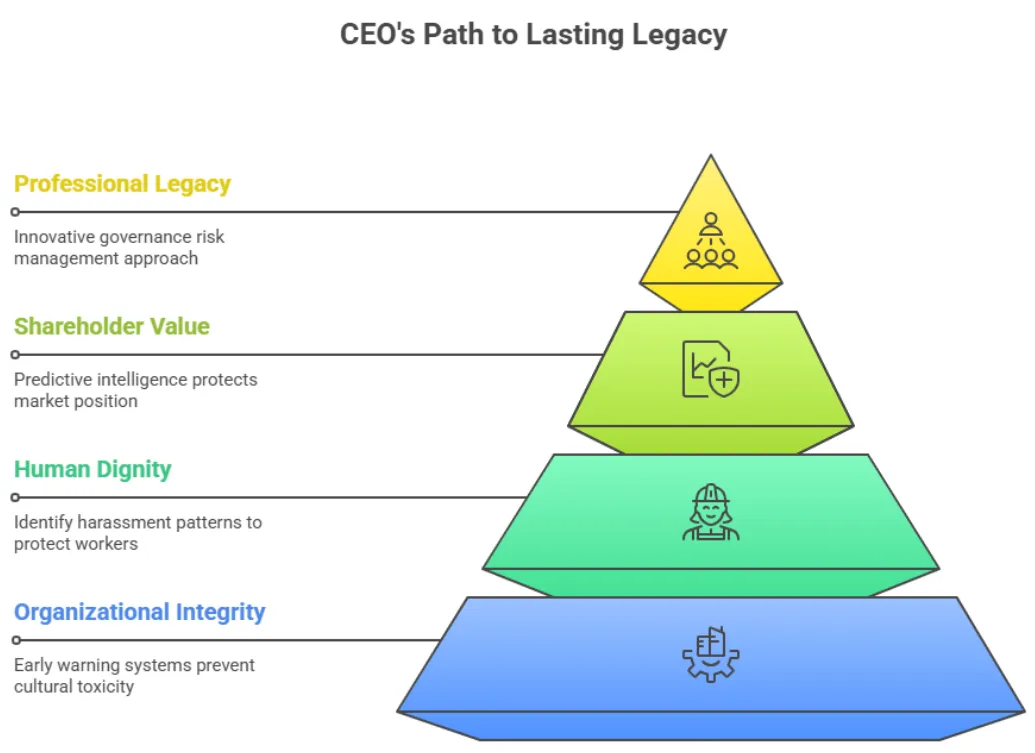
Management Control, Legal & Risk, and External Auditors can only control what is obvious. Our Harassment Risk Assessment identifies and quantifies the toxicity red flags that are often overlooked by management, legal teams, and external auditors:
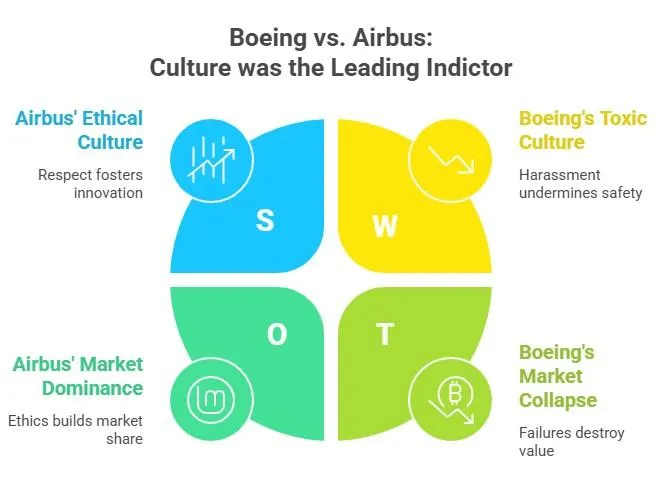
Air India: Pilot retaliation, union restrictions, 18 months of harassment patterns → Boeing 787 crashes, June 2025
Boeing: John Barnett harassed to suicide → $60B destroyed 18 months later
Airbus: "Respect and Protect" culture → 37% outperformance
Titan: Safety director silenced → Submersible imploded
VW: Engineers intimidated → Emissions scandal
Steinhoff: Accountants bullied → €6.5B fraud
"Traditional defences catch disasters after bodies and billions fall. Harassment patterns reveal the underlying culture that permits them to occur before any harm is done. Companies that disregard their truth-tellers inadvertently cause harm to their shareholders."
Articles
Our affiliate courses are designed by experts who have years of experience and proven results in the affiliate marketing industry.
What must a graduate tolerate to keep an opportunity?
Hanlie Lizette Wessels
Article 02 | GBV & the Workplace
An unwanted touch. A humiliating remark. A threat. Pressure to resign.
For an established professional, challenging these behaviours can be difficult. For someone whose career has barely begun, the question may feel more immediate:
“If I speak up, will I still have a future here?”
Employers celebrate graduate recruitment, youth employment and investment in future leaders. But securing a first job is only the beginning. What happens inside that workplace matters.
An opportunity should never come with an unspoken price: tolerate harm to protect your future.
Findings from CLARITY, our workplace risk intelligence solution incorporating the Harassment Risk Assessment (HRA) and Harassment Risk Index (HRI), raise serious questions about what some young people encounter after the welcome presentations end.
What the assessments reveal
The accompanying graph highlights selected findings from two graduate/intern cohorts. With the South African CLARITY HRI benchmark set at 1 for each harassment type, the results show substantial differences in reported risk.
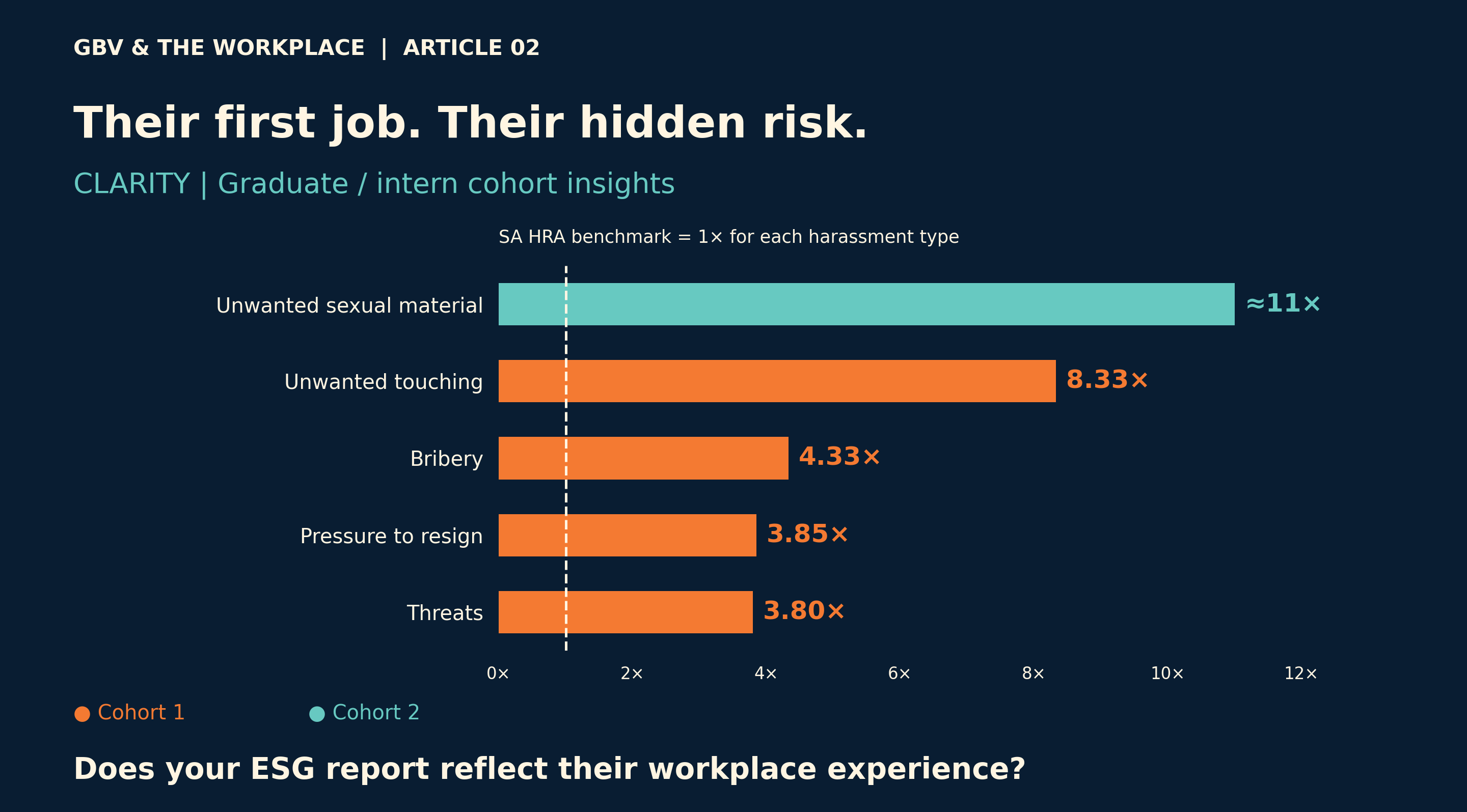
In Example 1, most categories were approximately two to four times the benchmark:
Unwanted touching: 8.33 times.
Bribery: 4.33 times.
Pressure to resign: 3.85 times.
Threats: 3.80 times.
Discrimination, humiliation, emotional abuse and constant personal criticism were also elevated.
In Example 2, the most pronounced spike was unwanted sexual material, at approximately 11 times the benchmark.
These are risk-score comparisons from two specific cohorts, not prevalence estimates for all South African graduates. They do not establish individual wrongdoing or explain every cause.
They are, however, findings that demand attention.
Your organisational average may conceal their experience
A board can receive an acceptable overall result while a small group within the organisation experiences substantially elevated risk.
Graduates and interns may be too few to move the overall score significantly. Their experience can disappear into the average.
That is why “our overall results look good” is an incomplete answer.
Good for whom?
For executives? Permanent employees? Established teams? Or also for the intern who depends on a supervisor’s recommendation to secure a permanent role?
CLARITY’s cohort-level analysis helps employers examine these differences and identify where further investigation and action are needed.
Who controls the opportunity - and who carries the risk?
A supervisor may influence a graduate’s rating, assignments, reference and prospects of appointment.
A policy may say, “Speak up.”
The employee may be thinking, “This person decides whether I stay.”
Publishing a reporting number does not establish that a young employee feels safe using it. Protection must be credible in practice: a route outside the reporting line, an impartial response, and attention to what happens after a concern is raised.
If criticism intensifies, opportunities disappear or exclusion begins, someone must examine the sequence of events. Those changes do not automatically prove retaliation. They cannot simply be ignored either.
Sexual harassment is part of a wider picture
The unwanted touching result in Example 1 warrants focused attention. So do the threats, humiliation and pressure to resign reported alongside it.
These findings do not prove that the same people were responsible or that the behaviours were connected. They show why employers need to investigate the broader environment.
Addressing sexual harassment while overlooking intimidation or humiliation can leave important parts of an employee’s experience unexplored.
A graduate should not have to understand the precise category of their mistreatment before an employer takes it seriously.
What kind of leaders are we developing?
Graduate programmes teach more than technical skills.
They teach people what authority looks like. What earns approval. Whether boundaries are respected. Whether organisational values apply when someone powerful is involved.
When humiliation is excused as “toughening them up”, what lesson is being taught?
When unwanted attention is dismissed as a joke, whose comfort matters?
When silence appears safer than reporting, what does the next generation learn about accountability?
Employers cannot credibly claim to develop future leaders while leaving harmful conduct in their training environment unexamined.
Recruitment, induction, mentoring and development are intended to build capability. Allowing harmful conditions to persist puts that investment - and the people behind it - at risk.
What does your ESG report say - and what does your graduate experience?
An organisation may report graduate appointments, training hours, youth employment expenditure and the number of young women entering its workforce.
Those achievements matter. But they leave a critical question unanswered:
What happens to those young people once they are inside?
An appointment count cannot tell us whether a graduate faces unwanted touching. Training expenditure cannot establish whether an intern can challenge humiliating treatment safely. A gender diversity statistic cannot show whether young women have a credible route to report someone who controls their career prospects.
The opportunity reported to stakeholders and the experience of the employee must be examined together.
This is where the social and governance dimensions of ESG meet: employees’ dignity and safety, and leadership’s responsibility to identify harm, act on it and monitor whether conditions improve.
CLARITY can inform that oversight by providing evidence of reported exposure, differences between workforce groups and changes across repeat assessments. That evidence should be considered alongside complaints, investigations and corrective action.
Low complaint numbers alone cannot establish that a program is safe. Employers also need to understand whether participants feel able to report.
If your ESG report celebrates investing in young people, can your board explain how it knows those young people are protected?
Leadership needs evidence, ownership and follow-through
Every organisation running a graduate or internship program should be able to answer:
Have we assessed this cohort separately, with safeguards for anonymity?
Do we know where risk is concentrated, including across placements and reporting relationships?
Can participants raise concerns outside the chain of authority that controls their opportunities?
Who is accountable for corrective action?
Have we checked whether conditions improved?
These questions belong with the executives sponsoring the program, alongside those responsible for people, risk, sustainability reporting and governance.
For South Africa’s workplace response to GBVF, young people’s first employment experiences deserve deliberate attention. Prevention must reach the places where careers begin and power is uneven.
Do you know whether your graduates and interns experience greater harassment risk than the rest of your workforce?
If you do not, reach out to explore how CLARITY’s HRA and HRI can help make those experiences visible, inform your enterprise risk assessment and direct action where it is needed.
A first job should open a future. It should never teach someone that keeping it requires surrendering their dignity.
Data note: Source: CLARITY HRA/HRI findings The Resilient Workplace Institute Impact Business Development (Pty) Ltd

Frequently Asked Questions
Have questions? We have answers.
"Isn't this just another expensive consulting fad that will be forgotten in two years?"
What we've developed is a data measurement system—like a financial audit, but for workplace culture. Our 18-question assessment maps directly to established ILO Convention 190 standards that 50+ countries have ratified into law. We're providing measurement tools for existing legal obligations, not creating new requirements.
The validation comes from 40+ South African organisations across multiple sectors, with measurable results showing correlation between harassment patterns and organisational failures 12-18 months before they become public scandals. This isn't theory—it's predictive intelligence.
"How can you possibly claim that workplace harassment predicts governance failures?"
We've analysed major corporate disasters—Titan submersible, Boeing 737 MAX, Wells Fargo fraud, Enron collapse, VW Dieselgate, Steinhoff accounting fraud, Theranos, FTX, and Wirecard—and found the same sequence every time:
1. Someone tried to raise concerns about safety, ethics, or compliance
2. They were systematically harassed, intimidated, or fired
3. Critical information was suppressed
4. Leadership operated on false data
5. Catastrophic failure occurred
David Lochridge at OceanGate warned about safety flaws and was fired within 3 days. John Barnett at Boeing faced "campaign of harassment, abuse and intimidation" until he developed PTSD. At VW, engineers questioning emissions software were silenced. Steinhoff whistle-blowers were intimidated before the €6.5 billion fraud collapsed the company.
The academic foundations are robust: Amy Edmondson's research on psychological safety, Morrison and Milliken's work on organizational silence. When you measure harassment systematically, you're measuring whether your organisation can process critical information effectively—the fundamental prerequisite for sound governance.
"Our employees will never answer honestly about harassment. They'll be too scared."
That's why our entire system is built around anonymity from the ground up. Responses are linked only to randomly generated machine codes—no personal identifiers. Yet we can still analyse patterns by department, employment level, demographic segments, and harassment sources (senior management, peers, contractors, clients) without compromising individual privacy.
We deploy assessments in multiple languages (currently five, expandable to any language) and consistently achieve 70%+ participation rates across sensitive sectors including government and mining.
Even if some don't participate, the organisational patterns emerge clearly. When 60% of a department reports intimidation from senior management, that tells you something actionable about your environment.
"This could create legal liability. What if we discover problems we didn't know about?"
Let's flip the question: Would you rather stay in the dark about risks that could destroy your organisation, or make those threats visible so you can address them proactively?
Which scenario creates more legal liability:
Scenario A: Discover harassment patterns through systematic assessment and take proactive action
Scenario B: Get blindsided by a major lawsuit, regulatory investigation, or governance scandal you could have prevented
Courts and regulators increasingly expect systematic approaches to workplace risks. Having assessment data strengthens your legal position by demonstrating due diligence. Our anonymisation approach provides risk intelligence without creating discoverable individual complaints.
"We already have HR policies and reporting mechanisms. Why do we need another system?"
You can only manage what you can measure. Your HR policies may be addressing problems that don't exist in your context, while real problems remain undetected because they have no policies.
Without systematic measurement, you operate on assumptions. You might have extensive sexual harassment policies while your actual problem is systematic intimidation from senior management. You might focus on peer harassment while missing contractor-based issues entirely.
Our assessment provides unprecedented granular intelligence:
- Department-by-department risk mapping
- Source identification (senior management, colleagues, contractors, clients)
- Demographic pattern analysis across employment levels and groups
- Policy gap identification showing what harassment types are actually prevalent vs. what your policies address
Traditional HR systems tell you "someone reported harassment." Our system tells you "harassment in Department X comes from senior management affecting recent graduates, while Department Y shows peer-to-peer patterns among mid-level employees." That's actionable intelligence for solving your actual problems.
"How do we know your data applies to our country/culture/industry?"
It's not about whether our data applies—it's about using proven methodology to gather real-time insight wherever you are.
Workplace harassment is a human phenomenon. The ILO's global study of 74,000 workers across 121 countries found 23% experience harassment worldwide.
Our culturally adaptive methodology generates localized intelligence through multilingual deployment and detailed analysis specific to your context: department-by-department mapping, harassment source identification, and demographic patterns unique to your organisational reality.
Think of it as a thermometer—it works the same way globally, but your results are your unique intelligence, delivered in your language, analysed through your cultural lens.
"Isn't this just political correctness disguised as business intelligence?"
This isn't about ideology—it's about bottom-line performance. Organizations with psychologically safe cultures significantly outperform toxic competitors: +28% profitability, +47% innovation output, +39% productivity, +56% employee retention. Companies with highest harassment rates underperform the stock market by 19.9%.
Harassment victims take 58% more sick leave, while 67% of harassment targets lose their jobs, creating massive recruitment costs (21% of annual salary) and knowledge loss. Organizations addressing harassment patterns see 35% productivity improvements in affected departments.
Sector-specific returns are substantial:
- Financial Services: +34% client satisfaction, +28% compliance
- Manufacturing: -47% accidents, +32% quality
- Mining: -51% safety incidents, +23% productivity
- Government: +38% service delivery, +43% retention
This isn't about feelings—it's about conditions where talent and capital generate maximum returns.
"What if this stirs up issues that were manageable before?"
This is like asking whether medical diagnostics create problems by identifying diseases. The problems exist whether you measure them or not—measurement makes them visible for systematic action.
Unaddressed harassment escalates over time. What seems "manageable" today becomes tomorrow's lawsuit, regulatory investigation, or talent exodus. Early intervention is always less disruptive and less expensive than crisis management.
Our approach helps you address issues gradually and strategically rather than waiting for public explosions. You control the process and outcomes.
"We're not a large corporation. Is this overkill for smaller organisations?"
Size makes this more important. Large corporations could possibly absorb losses; smaller organisations cannot.
When you lose a key employee to harassment (67% of targets leave), smaller organisations feel immediate impact. The operational impacts hit harder: 58% higher absenteeism and 35% productivity decline in one department affects your entire bottom line.
Our detailed analysis shows exactly where problems originate—senior management, peers, or external sources—enabling precise interventions. Having demonstrable healthy culture with data becomes your competitive advantage in talent markets.
Smaller organisations often see faster, more dramatic improvements because every person's enhanced performance is immediately visible.
"What if we get bad results? Will you publish that our organisation is toxic?"
Absolutely not. Assessment results belong to you, period. We maintain strict client confidentiality and never publish individual organisation results.
Our approach provides detailed organisational intelligence while maintaining complete anonymity. You receive unprecedented insight into where risks are concentrated and what's driving them, but all data remains confidential.
We do publish aggregated, anonymised research (e.g., "harassment from senior management affects 40% more women in financial services") without any organisation identification. Many organisations choose to share results for policy research value, but this is entirely voluntary.
"How long does this process take? We don't have time for lengthy implementations."
Total timeline: 6-8 weeks from start to actionable insights.
- Weeks 1-2: Platform customisation and communication strategy
- Weeks 3-4: Assessment deployment (2-week participation window)
- Weeks 5-6: Data analysis and report generation
- Week 7: Results presentation and action planning
Assessment takes 10-15 minutes per person. Most heavy lifting is done by our team.
Compare this to months or years recovering from harassment lawsuits or governance scandals.
"What if we measure everything and then nothing changes?"
Measurement without action is pointless. Our methodology includes specific intervention frameworks tied to assessment results. We provide prioritised action plans, resource allocation guidance, and follow-up assessment cycles to track progress.
The assessment is only valuable if you're committed to acting on results. If you want a shelf report, this isn't the right tool. If you want actionable intelligence to build a more resilient organisation, the assessment provides the roadmap.
Organisations seeing most benefit view this as systematic cultural risk management, not a one-time exercise. Like financial auditing—the value comes from regular organisational oversight..
Learn how the Harassment Risk Index is reshaping how governments, researchers, and companies act on workplace dignity.
Useful Links
© 2025 The Resilient Workplace Institute. All Rights Reserved.