VALIDATED ACROSS 40+ COMPANIES • ILO CONVENTION 190 ALIGNED
Innovative leadership transforms organisations with our groundbreaking, data-driven harassment risk assessment. We help prevent catastrophic failures, reduce losses, boost productivity, and retain top talent, all while shielding workers and their families from the devastating effects of workplace harassment.


Our Founding Mission
The Resilient Workplace Institute is a non-profit organisation with Public Benefit Status dedicated to making workplaces safer and more dignified whilst preventing catastrophic governance failures. Our mission is to make harassment risk visible, measurable, and preventable on a global scale—protecting both human dignity and organisational integrity.
We discovered that harassment systematically silences the voices that could prevent disasters—whilst simultaneously destroying the lives of those who tried to speak up.
Our Solution: The Harassment Risk Index
The HRI is the world's first diagnostic tool providing 12-18 months early warning of governance collapse whilst simultaneously protecting workers from immeasurable suffering.
For Governments, Companies & Institutions: We transform workplace harassment from an unmeasured liability into quantifiable competitive intelligence that drives profitability, retention, operational excellence, and Enterprise Risk Management.

40+Companies

79k+Data Points Analyzed

3 out 10Report High Harassment
"Culture is not a mystery—it's measurable."
The 10 Golden Nuggets That Transform Workplaces
01
Predict What's Coming
Detect early warning signs 18 months ahead.
02
Target With Precision
Pinpoint harassment hotspots by team, level, or demographic.
The Silent Risk
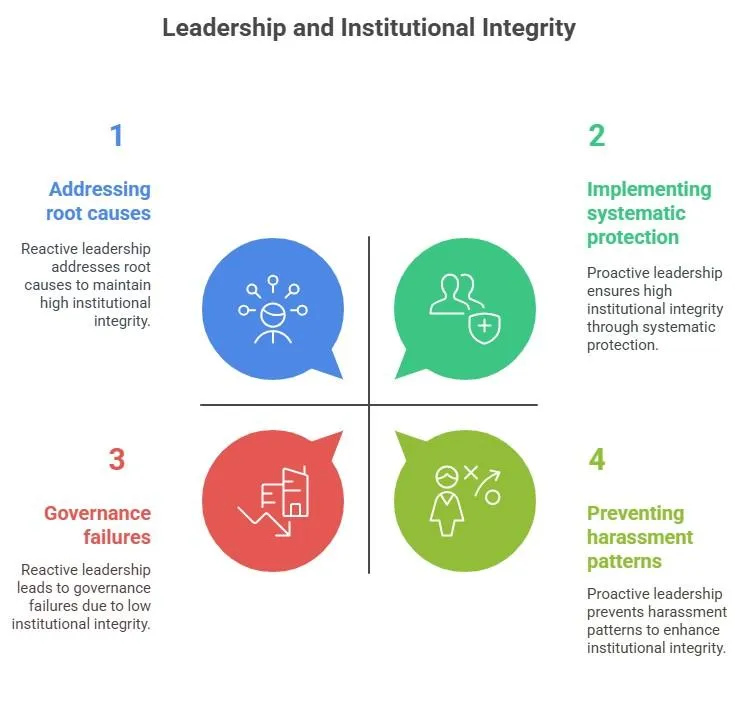
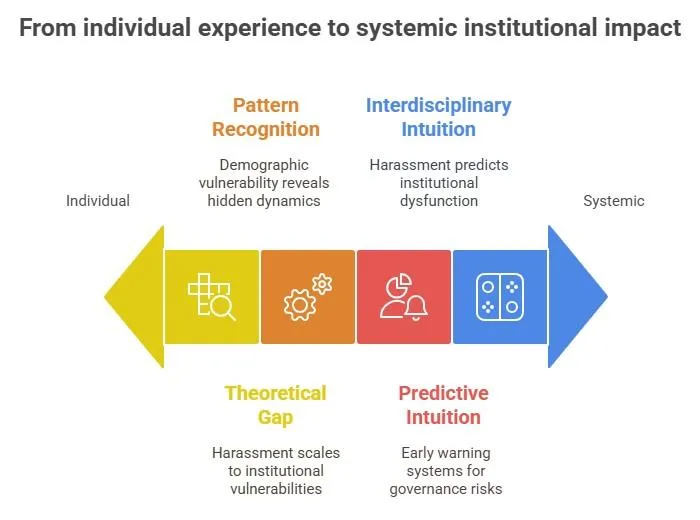
Harassment isn't just an HR issue; it’s a measurable early warning sign of systemic governance failure.
03
Benchmark Your Culture
Compare across departments, industries, and national averages.
04
Protect Strategy
Neutralize the cultural toxins that undermine your strategy.
05
Make the Invisible Measurable
Quantify workplace toxicity with a risk index grounded in real data.
Beyond Sentiment
We measure concrete behaviors, not just feelings, transforming vague cultural assessments into predictive, quantifiable intelligence.
06
Turn Risk into ROI
Track savings in absenteeism, turnover, and productivity.
07
Build ESG Credibility
Prove your "S" in ESG with metrics that align with ILO C190.
08
Boost Resilience & Innovation
Psychological safety drives adaptive, high-performing teams.
09
Empower Leaders with Truth
Bridge the gap between leadership perception and employee reality.
10
Diagnose Culture
Understand the root causes of issues, not just the symptoms.
Who We Help
We provide tailored tools and insights for leaders across all sectors. Click a role to learn more.
Set the Standard
Benchmark ILO C190 and SDG 10.3.1 progress using aggregate data
New Data. New Research.
Access anonymised harassment risk patterns and prevalence heatmaps.
Equip Inspection Systems
Apply risk insights to national enforcement and employer compliance.
Measure What Matters
Reduce harassment, improve culture, and report on psychological safety.
Get an Investment Edge
Get a leading indicator that reveals more than what is obvious.
For POLICY INFLUENCERS & ILO TECHNICAL STAFF
A Robust, Scalable Approach
The Harassment Risk Index (HRI) offers policymakers and international institutions a robust approach to measuring workplace harassment. Developed using anonymised data from over 40 companies, the HRI enables countries to:
Monitor alignment with SDG indicator 10.3.1.
Operationalise Convention 190 reporting using empirical benchmarks.
Compare sector- or gender-specific harassment trends.
Support labour law reform, enforcement, and resource planning.
For ACADEMICS & LABOUR RESEARCHERS
Access Research-Grade Data on Workplace Harassment Risk
Seeking novel data on workplace well-being? The HRI offers a rich, anonymised dataset with segmentations by gender, race, sector, and job level from 40+ company assessments.
Provides prevalence data from 40+ company assessments
Allows for comparison of top harassment types across demographics
Enables pattern analysis across time, geography, and industry
Collaborate With Us
We're working with leading South African universities and welcome proposals for joint publications.
FOR GOVERNMENT POLICYMAKERS & LABOUR INSPECTORS
Equip Your Inspection Framework with Risk Intelligence
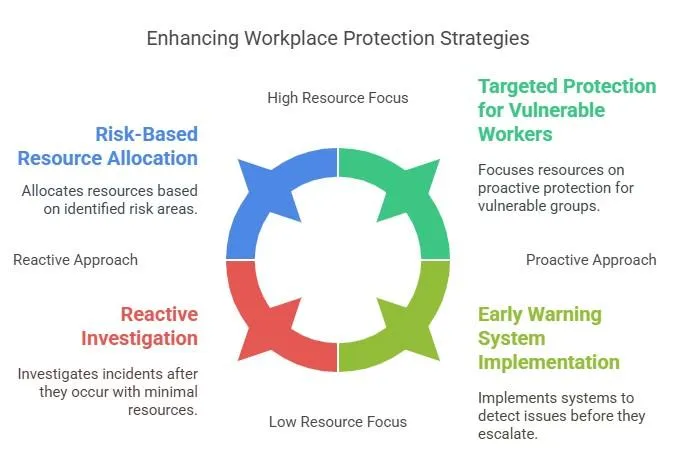
Labour departments and national authorities can use the Harassment Risk Index to proactively identify, address, and monitor workplace risk across sectors. Our government toolkit includes:
Templates for integrating HRI data into employer reporting
Policy briefs on C190 operationalisation using quantifiable benchmarks
Sample visual reports and dashboards for oversight bodies
Insights into how South Africa is building a national harassment risk baseline
FOR CORPORATE DELEGATES & HR EXECUTIVES
Reduce Risk. Boost Culture. Quantify Impact.
Companies lose millions each year due to workplace harassment—through sick leave, disengagement, and turnover. The Harassment Risk Index helps:
Measure the extent and types of harassment risk employees face
Prioritise interventions based on real-time data
Monitor improvements over time and align with ESG goals
Insights into how South Africa is building a national harassment risk baseline
Clients report measurable improvements in culture and accountability.
For Investors & Portfolio Managers
Three Levels of Risk Management Blind Spot in Your Due Diligence
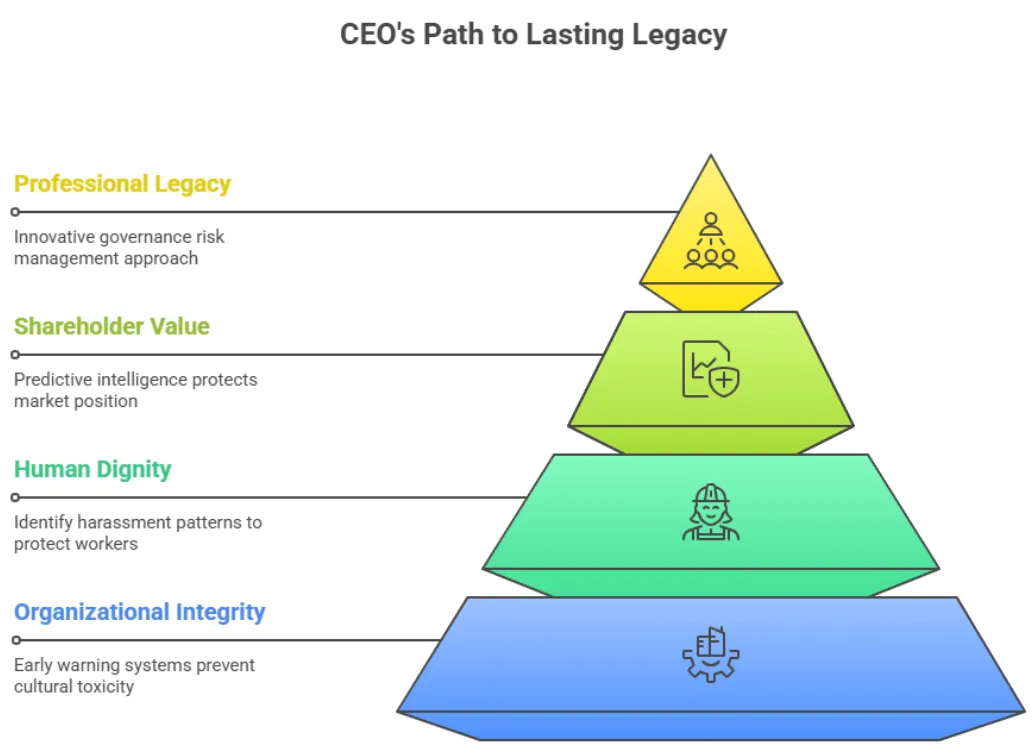
Management Control, Legal & Risk, and External Auditors can only control what is obvious. Our Harassment Risk Assessment identifies and quantifies the toxicity red flags that are often overlooked by management, legal teams, and external auditors:
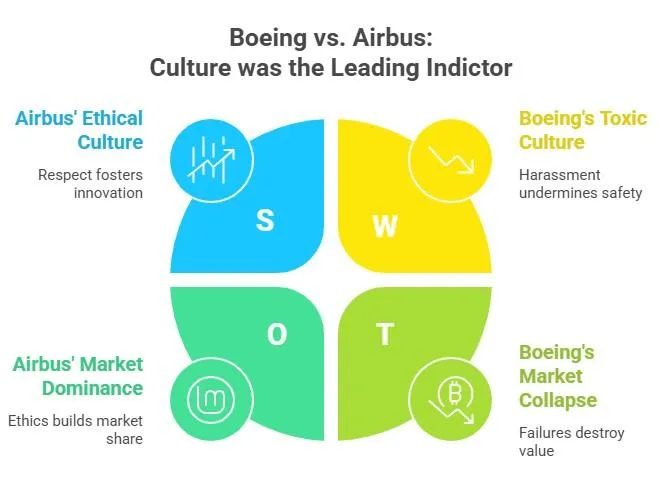
Air India: Pilot retaliation, union restrictions, 18 months of harassment patterns → Boeing 787 crashes, June 2025
Boeing: John Barnett harassed to suicide → $60B destroyed 18 months later
Airbus: "Respect and Protect" culture → 37% outperformance
Titan: Safety director silenced → Submersible imploded
VW: Engineers intimidated → Emissions scandal
Steinhoff: Accountants bullied → €6.5B fraud
"Traditional defences catch disasters after bodies and billions fall. Harassment patterns reveal the underlying culture that permits them to occur before any harm is done. Companies that disregard their truth-tellers inadvertently cause harm to their shareholders."
Articles
Our affiliate courses are designed by experts who have years of experience and proven results in the affiliate marketing industry.
Assessments FAQs
Assessments FAQs
❓ What is the purpose of the survey?
❓ Who is conducting the survey?
❓ Will I be asked for my name or ID?
❓ What personal information is collected?
❓Is the experience the same for everyone?
❓Do I play a role in improving my work environment?
❓ Can my responses be traced back to me?
❓ Can gender and job level identify me?
❓ What happens if my group is very small?
❓Are my answers visible to management?
❓ How long does the survey take?
❓ What happens after the survey?
You can read more on the survey HERE
Participating in workplace surveys can create different concerns. Employees in leadership positions may worry about being blamed, while others may fear being targeted. However, when surveys are conducted in ways that protect all participants and focus on generating insights rather than assigning blame, they enable organisations to make informed decisions that support long-term sustainability. This benefits employees, employers, and the broader environment.
To support clarity and build confidence, below are some frequently asked questions to assist employees.
❓ What is the purpose of the survey?
To understand employee experiences and identify opportunities to improve the workplace, including engagement, wellbeing, and respectful behaviour.
This is a learning and improvement initiative, not a reporting or disciplinary process.
❓ What will the survey cover?
The survey includes three areas:
Employee Engagement
Harassment Risk Assessment (workplace respect and behaviour)
Burnout (wellbeing, stress, and workload)
❓ Who is conducting the survey?
The survey is conducted and managed independently by the Resilient Workplace Institute.
This ensures confidentiality and independent handling of all data.
❓ Why should I participate?
Your participation helps ensure that the real employee experience is understood and acted on.
🎯 What’s in it for you
A chance to highlight workload and pressure points
Input into improving your day-to-day work environment
Strengthening respect and fairness in the workplace
Helping leadership make better, informed decisions
Contributing to a more sustainable and supportive environment
❓ Will I be asked for my name or ID?
No. You will not be asked for your name, ID number, email address, or employee number.
❓ What personal information is collected?
No personal identifiers are collected.
You may be asked to select general categories such as:
Gender
Job level
This is used to understand patterns across groups — not individuals.
❓Is the experience the same for everyone?
No. Employees do not experience these conditions in the same way.
Workplace experiences vary based on factors such as:
Job role and level
Team dynamics and leadership
Workload and environment
Individual circumstances
❓Do I play a role in improving my work environment?
Improving the workplace is a shared responsibility — not only management’s.
🔍 What this means
Leadership is responsible for:
Setting standards
Taking action based on insights
Creating the conditions for a safe and respectful workplace
Employees play an important role by:
Participating honestly in initiatives like this survey
Treating others with respect
Contributing to a positive and professional environment
🎯 Why your role matters
A workplace is shaped by daily behaviour, not just policies.
👉 When employees:
Speak up (safely and anonymously)
Engage constructively
Support respectful interactions
It helps create a workplace where:
Issues are identified earlier
Risks are reduced
Teams function more effectively
🔒 How this survey supports your role
This survey gives you a safe, anonymous way to contribute:
No names or identifiers
No risk of being singled out
Your input contributes to real insight and action
❓ Can my responses be traced back to me?
No. Your responses are completely anonymous and cannot be linked to any individual.
❓ Can gender and job level identify me?
No. These are broad categories and are not linked to any personal identifiers.
❓ What happens if my group is very small?
To protect anonymity:
Results are only reported where there are enough responses in a group
Small groups (e.g. a specific gender at a specific job level) will be:
Combined with a larger group, or
Only included in the summary view
👉 This ensures that no individual can be identified under any circumstances
❓ Who will see my responses?
Individual responses are never shared. Your responses are grouped (aggregated) into the overall results.
We report the summary insights to Management, who will plan interventions to reduce patterns as needed. The outcome and the planned actions will be shared with employees.
❓Are my answers visible to management?
No. Neither managers nor the organisation will have access to individual responses.
❓ How is my data protected?
Responses are:
Collected securely
Stored without identifying information
Processed using non-identifiable system-generated codes
Analysed independently by a third party
❓ How long does the survey take?
Approximately 5–10 minutes.
❓ Why should I participate?
Your input helps:
Improve working conditions
Strengthen respect and fairness
Address workload and wellbeing challenges
Support better leadership decisions
👉 If it is not measured, it cannot be improved.
❓ What happens after the survey?
Once the survey closes:
Responses are analysed independently by the Resilient Workplace Institute
Results are compiled into a structured report
Findings are presented to leadership in an aggregated (anonymous) format
Priority areas for improvement are identified
A summary of key findings is shared with employees
Next steps and planned actions are communicated
👉 You will see both what was found and what will be done about it
❓ When will we receive feedback?
After the survey closure, the report will be prepared and discussed with management in the month thereafter. Employees can expect to receive feedback within 2 months after the survey.
About The Resilient Workplace Institute
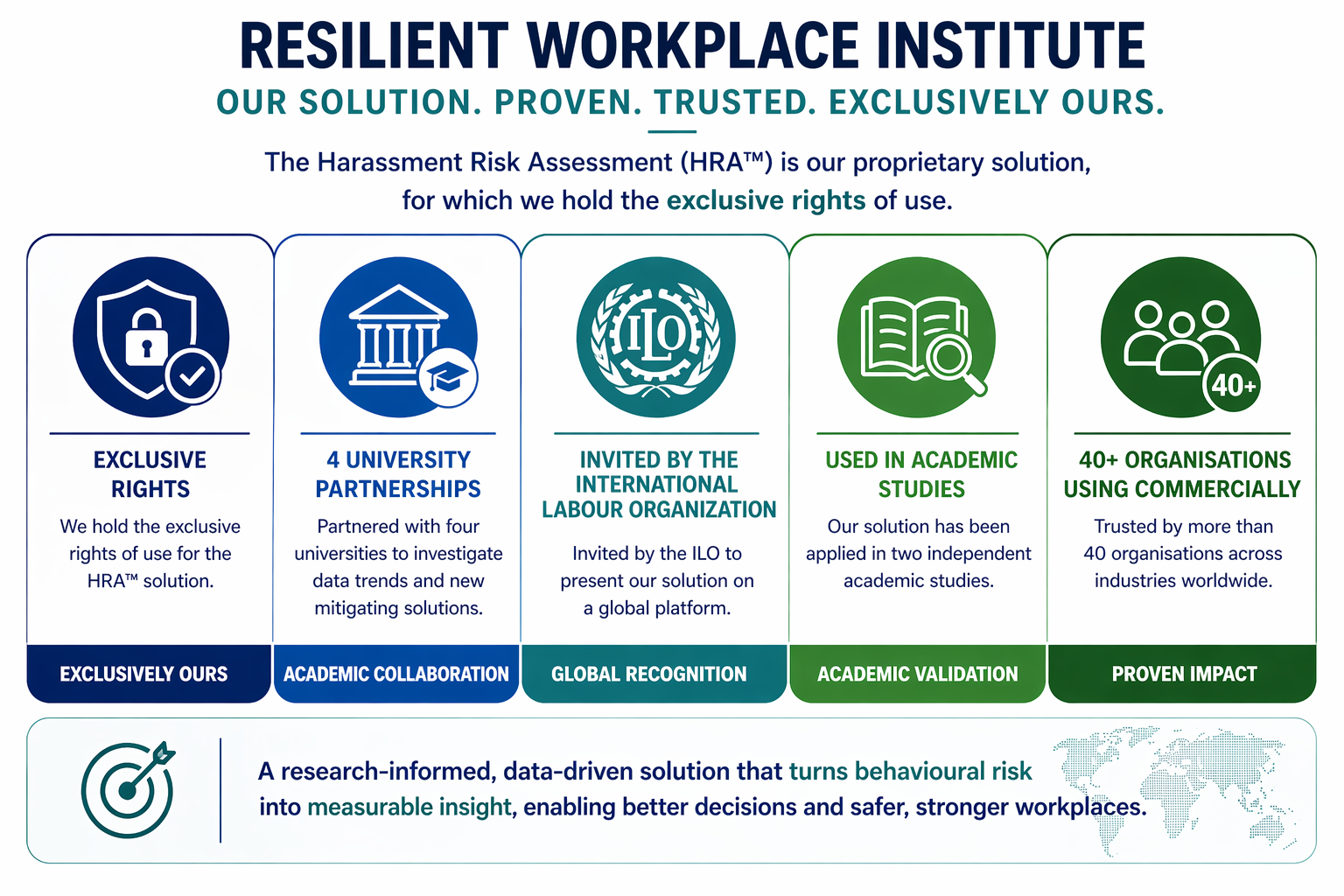
The HRA™ is an exclusively held, research-informed solution, supported by university partnerships to investigate data outcomes, presented at the International Labour Organisation, validated in academic studies, and trusted by over 40 organisations.
Read our Whitepaper HERE for deeper insight into the data and a ranking of harassment types.
For more information or a discussion: https://hanlie.resilientwork.org/

Frequently Asked Questions
Have questions? We have answers.
"Isn't this just another expensive consulting fad that will be forgotten in two years?"
What we've developed is a data measurement system—like a financial audit, but for workplace culture. Our 18-question assessment maps directly to established ILO Convention 190 standards that 50+ countries have ratified into law. We're providing measurement tools for existing legal obligations, not creating new requirements.
The validation comes from 40+ South African organisations across multiple sectors, with measurable results showing correlation between harassment patterns and organisational failures 12-18 months before they become public scandals. This isn't theory—it's predictive intelligence.
"How can you possibly claim that workplace harassment predicts governance failures?"
We've analysed major corporate disasters—Titan submersible, Boeing 737 MAX, Wells Fargo fraud, Enron collapse, VW Dieselgate, Steinhoff accounting fraud, Theranos, FTX, and Wirecard—and found the same sequence every time:
1. Someone tried to raise concerns about safety, ethics, or compliance
2. They were systematically harassed, intimidated, or fired
3. Critical information was suppressed
4. Leadership operated on false data
5. Catastrophic failure occurred
David Lochridge at OceanGate warned about safety flaws and was fired within 3 days. John Barnett at Boeing faced "campaign of harassment, abuse and intimidation" until he developed PTSD. At VW, engineers questioning emissions software were silenced. Steinhoff whistle-blowers were intimidated before the €6.5 billion fraud collapsed the company.
The academic foundations are robust: Amy Edmondson's research on psychological safety, Morrison and Milliken's work on organizational silence. When you measure harassment systematically, you're measuring whether your organisation can process critical information effectively—the fundamental prerequisite for sound governance.
"Our employees will never answer honestly about harassment. They'll be too scared."
That's why our entire system is built around anonymity from the ground up. Responses are linked only to randomly generated machine codes—no personal identifiers. Yet we can still analyse patterns by department, employment level, demographic segments, and harassment sources (senior management, peers, contractors, clients) without compromising individual privacy.
We deploy assessments in multiple languages (currently five, expandable to any language) and consistently achieve 70%+ participation rates across sensitive sectors including government and mining.
Even if some don't participate, the organisational patterns emerge clearly. When 60% of a department reports intimidation from senior management, that tells you something actionable about your environment.
"This could create legal liability. What if we discover problems we didn't know about?"
Let's flip the question: Would you rather stay in the dark about risks that could destroy your organisation, or make those threats visible so you can address them proactively?
Which scenario creates more legal liability:
Scenario A: Discover harassment patterns through systematic assessment and take proactive action
Scenario B: Get blindsided by a major lawsuit, regulatory investigation, or governance scandal you could have prevented
Courts and regulators increasingly expect systematic approaches to workplace risks. Having assessment data strengthens your legal position by demonstrating due diligence. Our anonymisation approach provides risk intelligence without creating discoverable individual complaints.
"We already have HR policies and reporting mechanisms. Why do we need another system?"
You can only manage what you can measure. Your HR policies may be addressing problems that don't exist in your context, while real problems remain undetected because they have no policies.
Without systematic measurement, you operate on assumptions. You might have extensive sexual harassment policies while your actual problem is systematic intimidation from senior management. You might focus on peer harassment while missing contractor-based issues entirely.
Our assessment provides unprecedented granular intelligence:
- Department-by-department risk mapping
- Source identification (senior management, colleagues, contractors, clients)
- Demographic pattern analysis across employment levels and groups
- Policy gap identification showing what harassment types are actually prevalent vs. what your policies address
Traditional HR systems tell you "someone reported harassment." Our system tells you "harassment in Department X comes from senior management affecting recent graduates, while Department Y shows peer-to-peer patterns among mid-level employees." That's actionable intelligence for solving your actual problems.
"How do we know your data applies to our country/culture/industry?"
It's not about whether our data applies—it's about using proven methodology to gather real-time insight wherever you are.
Workplace harassment is a human phenomenon. The ILO's global study of 74,000 workers across 121 countries found 23% experience harassment worldwide.
Our culturally adaptive methodology generates localized intelligence through multilingual deployment and detailed analysis specific to your context: department-by-department mapping, harassment source identification, and demographic patterns unique to your organisational reality.
Think of it as a thermometer—it works the same way globally, but your results are your unique intelligence, delivered in your language, analysed through your cultural lens.
"Isn't this just political correctness disguised as business intelligence?"
This isn't about ideology—it's about bottom-line performance. Organizations with psychologically safe cultures significantly outperform toxic competitors: +28% profitability, +47% innovation output, +39% productivity, +56% employee retention. Companies with highest harassment rates underperform the stock market by 19.9%.
Harassment victims take 58% more sick leave, while 67% of harassment targets lose their jobs, creating massive recruitment costs (21% of annual salary) and knowledge loss. Organizations addressing harassment patterns see 35% productivity improvements in affected departments.
Sector-specific returns are substantial:
- Financial Services: +34% client satisfaction, +28% compliance
- Manufacturing: -47% accidents, +32% quality
- Mining: -51% safety incidents, +23% productivity
- Government: +38% service delivery, +43% retention
This isn't about feelings—it's about conditions where talent and capital generate maximum returns.
"What if this stirs up issues that were manageable before?"
This is like asking whether medical diagnostics create problems by identifying diseases. The problems exist whether you measure them or not—measurement makes them visible for systematic action.
Unaddressed harassment escalates over time. What seems "manageable" today becomes tomorrow's lawsuit, regulatory investigation, or talent exodus. Early intervention is always less disruptive and less expensive than crisis management.
Our approach helps you address issues gradually and strategically rather than waiting for public explosions. You control the process and outcomes.
"We're not a large corporation. Is this overkill for smaller organisations?"
Size makes this more important. Large corporations could possibly absorb losses; smaller organisations cannot.
When you lose a key employee to harassment (67% of targets leave), smaller organisations feel immediate impact. The operational impacts hit harder: 58% higher absenteeism and 35% productivity decline in one department affects your entire bottom line.
Our detailed analysis shows exactly where problems originate—senior management, peers, or external sources—enabling precise interventions. Having demonstrable healthy culture with data becomes your competitive advantage in talent markets.
Smaller organisations often see faster, more dramatic improvements because every person's enhanced performance is immediately visible.
"What if we get bad results? Will you publish that our organisation is toxic?"
Absolutely not. Assessment results belong to you, period. We maintain strict client confidentiality and never publish individual organisation results.
Our approach provides detailed organisational intelligence while maintaining complete anonymity. You receive unprecedented insight into where risks are concentrated and what's driving them, but all data remains confidential.
We do publish aggregated, anonymised research (e.g., "harassment from senior management affects 40% more women in financial services") without any organisation identification. Many organisations choose to share results for policy research value, but this is entirely voluntary.
"How long does this process take? We don't have time for lengthy implementations."
Total timeline: 6-8 weeks from start to actionable insights.
- Weeks 1-2: Platform customisation and communication strategy
- Weeks 3-4: Assessment deployment (2-week participation window)
- Weeks 5-6: Data analysis and report generation
- Week 7: Results presentation and action planning
Assessment takes 10-15 minutes per person. Most heavy lifting is done by our team.
Compare this to months or years recovering from harassment lawsuits or governance scandals.
"What if we measure everything and then nothing changes?"
Measurement without action is pointless. Our methodology includes specific intervention frameworks tied to assessment results. We provide prioritised action plans, resource allocation guidance, and follow-up assessment cycles to track progress.
The assessment is only valuable if you're committed to acting on results. If you want a shelf report, this isn't the right tool. If you want actionable intelligence to build a more resilient organisation, the assessment provides the roadmap.
Organisations seeing most benefit view this as systematic cultural risk management, not a one-time exercise. Like financial auditing—the value comes from regular organisational oversight..
Learn how the Harassment Risk Index is reshaping how governments, researchers, and companies act on workplace dignity.
Useful Links
© 2025 The Resilient Workplace Institute. All Rights Reserved.